For many military families, practical, mission-focused career paths matter. An HVAC education gives veteran children a way to build with their hands, think with their heads, and serve their communities through safe, efficient comfort systems. Heating, ventilation, and air conditioning isn’t just about temperature—it’s about health, energy efficiency, and reliability in every season. With hands-on labs, real equipment, and job-ready coaching, the right training can turn core values like discipline, teamwork, and resilience into a steady, meaningful career. As demand for quality installation and energy-smart upgrades grows, now is a powerful time for military-connected students to learn the craft and step confidently into the field.
Why HVAC Training Fits Military Families and Veteran Children
HVAC is a natural fit for veteran children because it rewards the habits that military families model every day: punctuality, problem-solving, and pride in workmanship. It’s a field grounded in real-world results. You diagnose a comfort complaint, measure pressures and temperatures, correct airflow, and confirm performance—then the space feels better. That instant, measurable impact motivates many who grew up watching service members solve urgent problems under pressure.
Career stability is another standout benefit. Comfortable, healthy buildings are a necessity in every town and on every base, which means HVAC opportunities are widely available. From residential service to light commercial work, from new-build installations to retrofits, skilled technicians are in demand year-round. Electrification initiatives, growth in heat pumps, and indoor air quality priorities all point to long-term job security and advancement potential.
Training designed with military families in mind goes beyond textbooks. Students learn with real tools in a lab, practice electrical safety, wire control boards, measure static pressure, set refrigerant charging, and troubleshoot thermostats and smart controls. The rhythm mirrors what many military-connected learners appreciate: clear procedures, repeatable checks, and data-driven decisions. Programs that blend hands-on classroom time with focused online modules offer flexibility for busy households, PCS moves, or part-time work.
Just as important, HVAC careers build community ties. Whether maintaining the comfort of a neighbor’s home or ensuring a school’s ventilation performs during flu season, technicians protect safety and well-being. That service mindset resonates with children of veterans who want their work to matter. If you’re exploring options, an HVAC course for veteran children can be a practical, purpose-filled path into a skilled trade where you can grow, specialize, and make a daily difference.
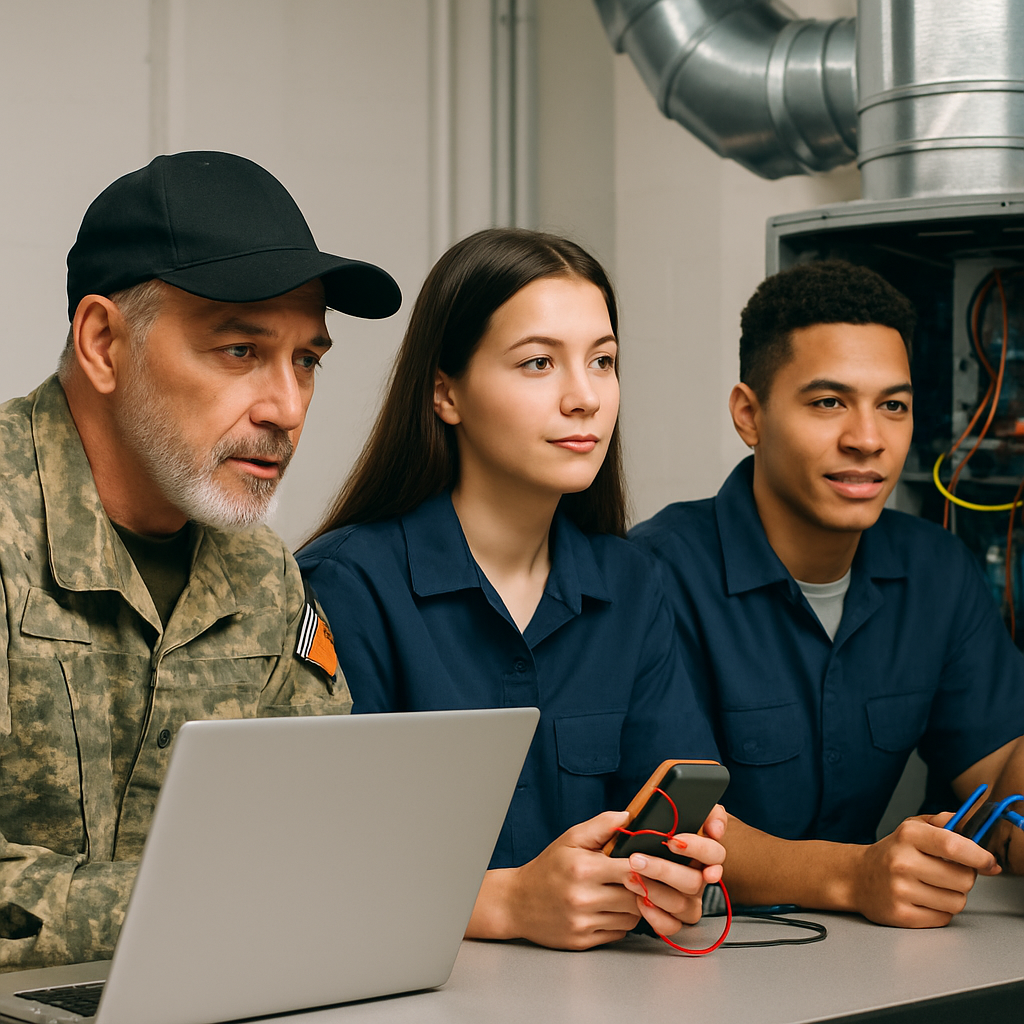
What a Military-Focused HVAC Curriculum Looks Like
A strong, military-aware curriculum is structured, progressive, and centered on real equipment. Foundations often start with safety, tools, and electrical basics—how to use a multimeter, read wiring diagrams, and follow lockout/tagout. From there, students learn the refrigeration cycle and master essential measurements: superheat, subcooling, and line temperature. They practice refrigerant charging with gauges and smart probes, then confirm system capacity under varying load conditions. In the same track, airflow fundamentals come to life: calculating CFM, interpreting fan tables, measuring total external static pressure, setting blower speeds, and identifying duct restrictions.
Design-focused modules emphasize high-quality installation. Students size equipment correctly, evaluate duct systems, and plan zoning for comfort across different spaces. Heat pump training covers defrost strategies, cold-climate performance considerations, balance point, and reversing valve diagnostics. Combustion labs cover furnace fundamentals: ignition sequences, flame rectification, manifold pressure, and combustion analysis for safety and efficiency. Layered throughout are customer communication skills, so graduates can explain findings clearly and build trust on every call.
Flexibility matters for veteran children, so many programs offer hybrid learning: online theory for evenings or between obligations, then intensive in-person labs for hands-on mastery. Some providers build scenario-based exercises that mirror common realities for military communities—troubleshooting a heat pump in on-base housing, balancing airflow in a multi-zone home, or solving salt-air corrosion issues near the coast. Capstone projects might include installing and commissioning a basic split system, documenting all readings, and preparing a professional service report that would make any crew chief proud.
Industry certifications prepare students to transition quickly into the field. EPA 608 test prep is standard; many programs also align training with NATE-ready knowledge checks and local apprenticeship requirements. Stackable micro-credentials—such as duct design essentials, airflow diagnostics, or “quality installation” verification—let students show immediate value to employers. Real-world examples show the path is achievable: a 19-year-old whose parent served in the Army completes a 12-week fundamentals course, earns EPA 608, interns with a local contractor, and within months is performing maintenance visits under senior supervision. With added training in heat pumps and controls, that same apprentice can progress to service technician and then to system design or team leadership.
Career Pathways, Funding, and How to Get Started
Entry-level roles typically include installer’s helper, maintenance technician, or shop support. With a fundamentals course and EPA 608, new hires can assemble line sets, braze under supervision, pull vacuum, check charge, set up thermostats, and complete seasonal maintenance. Within a year or two—especially with added training in airflow, system commissioning, and advanced troubleshooting—many move into lead install or service positions. From there, pathways branch into building performance, energy audits, indoor air quality, and even building automation and controls.
Demand is accelerating. Incentives for energy efficiency, the surge in variable-speed equipment, and widespread adoption of heat pumps mean contractors need techs who can measure, verify, and communicate. Homeowners expect not just equipment swaps but quality installation with documented results. Technicians who can read static pressure, design better duct runs, and dial in charge are the ones who advance—and earn—faster. For entrepreneurial veteran children, HVAC also offers a path to ownership. After several years mastering the craft and customer service, starting a small service business or specializing in design/commissioning becomes a realistic goal.
Funding options vary by region and program. Many training providers partner with workforce boards, employers, or community grants to keep tuition manageable. Scholarships for military families are common, and some schools extend discounts to dependents of veterans. Eligible students may also explore education benefits for dependents where applicable; the best practice is to speak directly with the training program’s admissions team and a veterans’ education counselor to verify current options. In parallel, employers often sponsor promising trainees—covering certification exams like EPA 608 or reimbursing tuition after a probationary period.
Getting started is straightforward. Brush up on basic math and electrical concepts; become comfortable with hand tools and safety practices. Look for a curriculum that emphasizes real equipment, measurable outcomes, and topics like system design, airflow diagnostics, zoning, heat pumps, refrigerant charging, and furnace fundamentals. Ask how labs are structured, how often students touch tools, and how job placement works with local contractors. Night or weekend options help balance family responsibilities, while hybrid formats allow steady progress from anywhere. As you train, build a portfolio—photos of clean installs, snapshots of gauge readings with before/after improvements, and commissioning checklists. That record of craftsmanship showcases what matters most in HVAC: safe practices, verified performance, and pride in the work—values that resonate deeply in military households and open doors to a resilient, respected career.

Vienna industrial designer mapping coffee farms in Rwanda. Gisela writes on fair-trade sourcing, Bauhaus typography, and AI image-prompt hacks. She sketches packaging concepts on banana leaves and hosts hilltop design critiques at sunrise.