Why AI Is Transforming Jewellery Visuals: Precision, Speed, and Storytelling
Jewellery is uniquely difficult to photograph. Polished metals bounce light like mirrors, gemstones refract and disperse color in complex ways, and tiny surfaces expose every dust mote or fingerprint. Traditional studio setups often require elaborate rigs, macro lenses, focus stacking, and meticulous retouching—work that can be costly and slow, especially when a collection spans dozens of SKUs and variants. This is where AI jewellery product photography is reshaping the craft. By merging physically informed rendering, machine learning, and smart automation, AI helps artisans and luxury brands present pieces with editorial finesse while maintaining consistency across campaigns, stores, and seasons.
At its core, AI-powered production can start from multiple input types: a design sketch, a CAD file, or an existing product shot. The system interprets metal types, gem cuts, and finishing details while preserving essential qualities like prong shape, micro-bevels, and surface polish. Advanced models can simulate softbox reflections on platinum, capture the subtle anisotropy on brushed gold, and render accurate dispersion for diamonds and colored stones. The result is clean, faithful imagery with the sparkle and contrast that shoppers expect—without the usual battle against harsh highlights or color casts.
Equally important is the ability to move from sterile packshots to evocative narratives. AI doesn’t stop at a white background; it enables on-model setups, stylized lifestyle scenes, and campaign concepts that match your brand’s visual language. With environment presets and lighting templates, a single ring can be visualized in a moody editorial close-up, an elegant flat-lay for print, and a crisp marketplace-compliant cutout. This accelerates experimentation and A/B testing, supporting faster decisions on which looks convert best. For brands balancing budget and scale, platforms now make AI jewellery product photography accessible as a drag-and-drop experience—generate 2K images for ecommerce grids, push 4K hero shots for print lookbooks, and keep every asset on-brief with reusable scene settings.
The move to AI also reduces operational friction. No shipping of prototypes to studios, fewer reshoots for minor iterations, and faster updates when metal tones, gemstone colors, or engravings change. Sustainability improves too: fewer physical samples and less freight for photo rounds. For teams juggling launches across ecommerce, social, and retail displays, the speed-to-asset advantage of AI can be the difference between catching a trend and missing it.
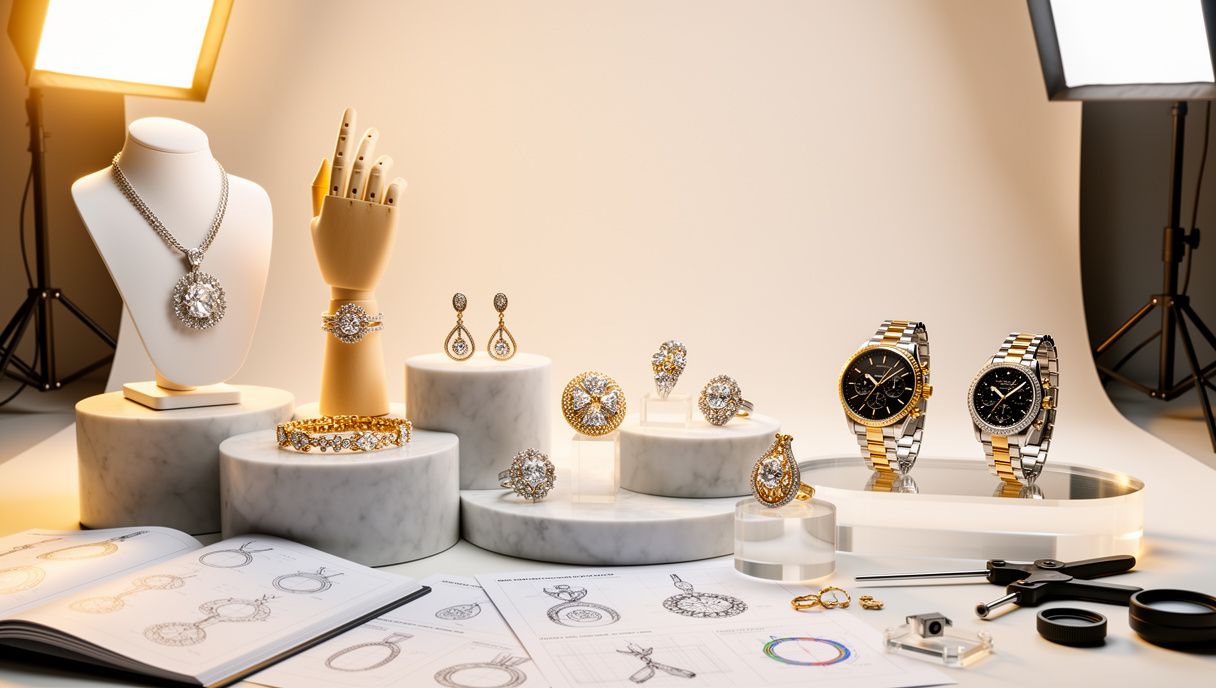
From CAD to Cart: A Practical Workflow for Studio-Quality AI Imagery
A successful AI workflow starts by clarifying intent: which channels need which variants, what styling is on-brand, and how each image supports conversion. Begin with your inputs—CAD files, design sketches, or baseline photography. Clean geometry so prongs, pavé settings, and micro-chamfers are accurate; small bevels matter because they catch realistic highlights. Assign physically based materials: specify karat and finish (mirror, satin, brushed), set index of refraction and dispersion for gemstones, and ensure stone cuts (round brilliant, emerald, cushion) map correctly to light behavior. This level of fidelity underpins believable sparkle without artificial glare.
Lighting determines emotion and clarity. Use virtual softboxes, flags, and reflectors to shape specular highlights on metal while avoiding blown-out hotspots. HDRI domes can add subtle environment cues, while rim lights help separate white-gold edges from white backgrounds. Simulated macro optics, depth of field, and focus stacking prevent the telltale flatness that plagues basic renders. Keep an eye on shadow density—gentle contact shadows ground the piece and improve perceived realism. For marketplaces that demand pure white, maintain a compliant background while retaining a faint, realistic shadow so the product doesn’t float unnaturally.
Color management is non-negotiable. Calibrate your pipeline with consistent white balance (e.g., D55), apply the correct tone curve, and proof key outputs against common device gamuts. This protects brand tones, yellow-gold warmth, and gemstone hue integrity across screens. If you plan for print, generate 4K masters and create CMYK-safe versions. During post, use intelligent cleanup to remove dust or artifacting, balance contrast for facet definition, and tame specular peaks. Smart editing tools can also produce variant sets at scale: yellow/white/rose gold versions, different carat sizes, and alternative center stones—all while preserving the same camera angle and lighting for visual consistency.
Output strategically. Produce crisp packshots for PDPs, detail crops that showcase prongs or hallmarks, and lifestyle cuts for banners. Generate on-model imagery—hands, neckline, or wrist—matched to your target audience’s style and skin tones, while maintaining correct scale against anatomy references. For ecommerce, export optimized 2K images with descriptive file names and alt text for SEO. For social, prepare vertical crops and short looped clips that catch light across facets. Finally, document your scene presets and asset metadata; this “brand studio in a box” ensures every new SKU can be rendered with the same AI jewellery product photography standard, without rebuilding from scratch.
Scaling Content for Growing Jewellery Brands: Scenarios, ROI, and Real-World Use
Consider a London-based artisan preparing a spring launch with ten rings and matching earrings. In a traditional shoot, scheduling models, shipping samples, and wrangling retouching could stretch for weeks. With AI, the designer turns CADs into lifelike packshots in hours, spins up a cohesive lifestyle set around natural stone textures, and tests two on-model looks to gauge audience resonance. The launch goes live faster, and the brand can reallocate budget to paid social while still producing editorial-grade visuals. Conversion lifts because shoppers see high-magnification detail, and returns drop as sizing and metal tone visuals are more accurate.
Now imagine a boutique watch retailer in Geneva creating a capsule campaign. High-polish bezels and sapphire crystals are notorious for unwanted reflections. Using AI-driven lighting templates, the team dials in clean specular highlights and refined crown detail while staying faithful to dial color. They output 4K hero shots for window posters and 2K ecommerce images aligned to marketplace standards. When a limited-edition strap arrives late, the retailer updates the model instantly—no reshoot, no downtime. This agility turns limited stock into a storytelling opportunity rather than a logistical headache.
For a New York D2C brand, seasonal trend agility is everything. AI enables rapid concept-to-reality: mood boards become fully realized campaign images, scaled across email headers, PDPs, and ads. A handed-down creative direction—“minimal, cool daylight, matte stone backdrops”—translates into reusable presets. Product variants (rose gold vs. white gold; ruby vs. sapphire center stones) are generated in parallel, simplifying merchandising. The team A/B tests lifestyle vs. on-figure hero images and finds a 12% CTR improvement on carousel ads that show realistic hand poses with soft morning light. With consistent on-brand packshots and cinematic lifestyle scenes, they unify the look across channels without overextending the budget.
Operationally, the ROI drivers are straightforward: fewer sample shipments, fewer reshoots, faster time to publish, and higher asset reuse. Marketing benefits include improved PDP engagement through meticulous macro detail, better SEO via structured alt text and descriptive filenames, and a steady cadence of fresh content for social and email. For wholesale or marketplace partners, AI supports instant compliance—pure white backgrounds, centered framing, and correct cropping—while still letting you maintain a premium identity in owned channels. When a collection expands or regional preferences emerge (e.g., warmer palettes for the Middle East, cooler minimalism for Northern Europe), creative variations can be spun up quickly without compromising the core aesthetic.
There are also best-practice safeguards. Always validate gemstone hue, metal warmth, and scale against reference samples to prevent expectation gaps. Include detail crops that disclose prong style, band thickness, and clasp mechanisms; transparency builds trust. For hallmarking or certification marks, render them legibly and consistently. And know when to hybridize: for one-of-a-kind stones with exotic inclusions or for ultra-high-end macro video requiring complex caustics, a boutique physical shoot may still complement the AI pipeline. The sweet spot is using AI as the scalable backbone—packshots, on-model, and lifestyle at volume—while reserving traditional capture for rare showpieces. Done well, this blend delivers the polish of a luxury studio, the speed of software, and the storytelling range needed to win modern shoppers.

Vienna industrial designer mapping coffee farms in Rwanda. Gisela writes on fair-trade sourcing, Bauhaus typography, and AI image-prompt hacks. She sketches packaging concepts on banana leaves and hosts hilltop design critiques at sunrise.